| |||||||||
Tweak's Guide to
|
![]() |
Budget controllers are most apt to compromise on the touch of the keyboard. This "touch" consists of may things. 1. The actual feel of the keyboard and its response to your hands. 2. The presence of velocity sensitivity. 3. Whether it has aftertouch or not. 4. Whether the keys are weighted or unweighted. All four of these variables combine to make your playing of the keyboard a pleasurable experience. As you go up in price you will find more of these 4 critical features implemented
1. Feel This is subjective to some extent, but most of you can quickly identify a cheap feeling keyboard. The keys will feel inconsistent when you press them; they may "bottom out" fast to even a slight touch, and have a flimsy cheap plastic feel. While all of these boards have plastic keyboards, there is a difference between cheap, thin plastic and plastic of better quality.
2. Velocity sensitivity. The harder you play, the higher the velocity value is sent to the computer for any given MIDI note. Nearly all software samplers and synths respond to velocity, which is used to control the loudness and timbre of the note. The presence of velocity can make your playing sound expressive. If you don't have velocity, the keyboard sends the same velocity value for every note, which can make even great playing uninspiring. So make sure you at minimum get a controller that transmits velocity sensitivity.
3. Aftertouch You engage aftertouch by pressing the keys down after the initial strike. They keyboard will send a range of 127 values as long as you are holding the key and modulating pressure. When implemented well, this is just like turning a knob. Is it important? Many software synths do not implement aftertouch, though many of the better ones do. Most hardware synths do respond to aftertouch. There are 2 basic kinds of aftertouch. The most common is channel (mono) aftertouch (sometimes called channel pressure) where only one data stream of aftertouch data is generated and it affects every key on the midi channel). The less common, but more complete implementation is called polyphonic aftertouch. Here each key sends out 127 values at the same time, which is harder to implement and generates a ton more MIDI data. Only a few software synths respond to polyphonic aftertouch
4. Weighted, semi weighted, unweighted action. You won't find fully weighted keys in a compact keyboard controller, but you may find it in 88 key controllers. "Weight" is added to the keys themselves and to the key travel mechanisms to make them respond more like a real piano's heavier keys do. This is usually not desirable in a compact keyboard controller, where playing fast is often desired. An "unweighted" keyboard offers little resistance. You can spot an unweighted keyboard by touching it; it will be extremely light feeling and the keys may be "springy". Many compact controllers are "semi-weighted". These also have a light touch but offer a little more resistance and consistency. They usually have a better feel for most people.
All Compact controller keyboards offer more controls than just the keys themselves. At minimum, you will find some kind of pitch and modulation controls, which may be in the form of two separate wheels or a single joystick which combines the functions. There is usually also an input on the back for connecting a sustain pedal. Next, some boards have some kind of ability to switch programs and banks. This is more important if you are controlling hardware midi synths, but less important for software instruments, where programs are more easily selected by the mouse, and which may not respond to these commands. Some controllers offer drum pads which can be assigned to the MIDI notes where drums usually reside on the keymap. (C0 to G1 typically). Often that is an important consideration for those who want a dedicated surface for triggering drums. The M-audio Axiom series is nice. Finally, and perhaps more importantly, the compact controller keyboard will have knobs, sliders, touch pads to send additional MIDI continuous controller commands (CC events). Typically, you can assign which CC events the knob or slider sends. That is a good thing because software instrument manufacturers may use different CC values for controlling the important parameters of the instruments. You can read more about how CC events are implemented in the guide article The Tweaker's Guide to MIDI Continuous Controller Commands.
There are 4 methods manufacturers use to get the knobs on the controller to match up with the parameters the software instrument uses. They are Automapping, Templates, Auto-learn functions, and of course, manual assignment of the controls. All of these solutions have advantages and drawbacks, and there is no perfect MIDI controller for all software instruments.
Auto mapping
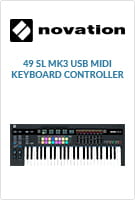
One of the more innovative approaches to the thorny problem of assigning the knobs on your controller to your software instruments is the "automap" facility developed by Novation for their ReMote SL series. I have reviewed the ReMote SL 37. The auto-mapping feature may map parameters you don't want mapped. A lot of times all you want to do is adjust a filter cutoff and resonance and you may have to look through dozens of parameters to find it.
Templates
Another approach is to allow the user to create and call up preset templates for different software instruments. Using preset templates means scrolling through a list a finding the template before you play and tweak. This approach can be effective when using software environments like Reason. Indeed many controllers have a template for using Reason.
Auto learning
Some software instruments allow the software to "learn" the controller values the keyboard controller sends. You press a button in software, touch a software knob, then touch a hardware knob on your controller and the link is learned by the software. This really has little to do with the controller and is done in the software instrument itself.
Manually assigning controls
Manually assigning knobs to software functions is can be tedious. When you change to a different soft synth that uses different values you have to reassign the controller. The good thing about simple manual assignments as many software instruments use common controls. Filter cutoff is usually CC74, Resonance is usually CC71 and effects are usually on CC91 and 93. Those are the most frequently used parameters for many common synths so having a controller with manual assignments works fine for most people most of the time. Going deeper than that requires that you concern yourself with the issues of auto mapping vs. templates vs., software learn functions.
Emu Xboard
49 49-Key MIDI Controller
Ok let's put it all together.
The key question (ouch) you have to ask yourself is, "will having just a handful of controls be enough?" I can tell you from experience that if you don't have fancy features on your controller you are unlikely to miss them. Indeed for a newbie, having all these controls can unnecessarily complicate your musical life. However, for the die hard tweak who loves to program synths the advanced boards give you a welcome alternative to tweaking by mouse and give you the hardware to sculpt and automate your tweaks in the sequencer.
The Feel of the board is pretty important. You would not want to buy a guitar with horrible action, right? Its the same with a keyboard. A good feeling board gives you confidence allows you to play with greater agility and speed.
Consider the size you need first, as if the keyboard is too big, it will give you endless problems in a small desktop environment. You won't have room for all the stuff you need there! Adding another foot to your keyboard might bump the control surface or mixer off the front table. You have to answer for yourself, do you have the room? Then figure out your budget and cross off any that exceed it. Then consider touch, check whether the board is semi weighted, offers velocity and aftertouch and make your list. Finally. consider the method used for assigning controllers. This often has you reflect upon which software instruments you have and intend to get. You should now be down to less than a handful of controllers. If you go through this process of decision making and research, you are likely to find the board you will be happy with.
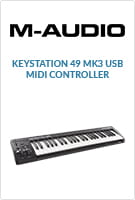
Yamaha KX49 49-Key Keyboard MIDI Controller
Tweak: The KX series comes with Cubase AI. The controller has a dedicated section for controlling Cubase 4 (or AI)
Tweak's review of the ReMote SL 37 by Novation
Go to the Next Class
Go Back to the Previous Class
Keyboards and Modules Index
Keyboards: What you need to know
Multi-Timbral Synths Compared
Choosing a Controller
MIDI CCs Explained
MIDI Modules
The Triton Family
The Motif Family
The Fantom Family
Keyboard Price List
Triton Rack and EXB Expansion Boards
Novation ReMore 37 SL
On Programming Synths
Emu Xtreme Lead -1
Proteus 2000
Korg Electribe EA1
Roland JV1010
Emu Planet Earth
Roland SRX boards
About MIDI Interfaces
Poll: Best Synth Under $600
Poll: Triton vs. Motif vs. Fantom
Forums: Korg M3
Forums: Trance Synths
|
TweakHeadz Lab | Studio-Central | Audio-Pro-Central | zZounds and online store Affiliations | Site Map | Support the Lab | Privacy Policy | ©2008 TweakHeadz.com |