The Mobile Recording Studio
|
GEAR for those on the Move!
Going 'Mo-Bile?
Travelling for the Holidays? You can take the studio along!
A laptop that will work for music applications.
|
Mark of the Unicorn (MOTU) UltraLite 10x14 FireWire Interface
with MIDI |
| The UltraLite bus-powered FireWire audio
interface delivers everything you need to turn your laptop or
desktop Mac or PC into a mobile 24-bit, 96kHz recording studio
with 10 inputs and 14 outputs. And because it's bus-powered,
the UltraLite gives you the ultimate freedom to make music
anywhere, anytime. |


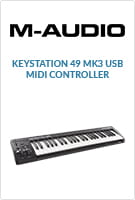
Good to have a small controller board like this one
MAudio Axiom 25 Keyboard MIDI Controller
Roland XV2020 64-Voice Expandable Synthesizer Module
The XV-2020 64-Voice Expandable Synthesizer Module puts Roland‰s flagship XV sounds in a convenient half-rack design complete with USB. Expandable via 2 SRX-Series Wave Expansion Boards, it‰s like a powerful ‹plug-inSˇ synth with up to 192MB of sounds, three independent effects processors and intuitive editing software.
Midiman Midisport 2x2
(Macintosh and Windows)
Add MIDI to your Notebook computer.
AKG K55 Headphones
Tweak: Don't forget these, unless you like the sound of one inch speakers.
|
|
A Midi and Audio Notebook Computer for Sequencing Anywhere and Everywhere
by Tweak
The
holidays. A time of traveling, often to see distant relatives and friends, loved ones and a time of good cheer. ...well that is how it is supposed to be, anyway. But for the true tweak, the holidays can be rife with angst and anxiety, being separated from our true loves, our studios! Up until this year, going on a long trip meant shutting down the studio, shutting down whatever projects were going, maybe grabbing a scratchpad or manuscript paper as you locked down, just in case a million dollar idea came to you as you lay in some strange bed, eyes wide open staring at the ceiling at 4am.
But times have changed. You now can please the significant other by going for an extended visit to your mother-in-laws for the holidays. It will be quite a good time no matter what happens because you can now take the studio along, and it will all fit in a briefcase. You've probably guessed I am talking about the amazing capabilities of the current crop of
notebook computers for song writing on digital audio sequencers with soft synths and soft samplers.
A number of technological developments have made the portable DAW a reality, and they are not about to stop. Witness:
- Notebook computers now have fast processors
- Larger memory capacity and disk capacity. Check the specs. Is it fast enough for any digital audio sequencer?
- The availability and low cost of software synths and samplers. This is what kick-started the idea for me. You can leave your midi modules at home and just bring your software stuff. Of course it is exactly here where a problem will arise with all but the fastest laptops.
- The availability of a notebook friendly
Firewire audio interfaces suitable for professional work. I advise skipping USB altogether and going straight into a Firewire solution.
- The availability of small MIDI keyboards, and more towards the bleeding edge, USB keyboards or even software keyboards (that let you play the computer keys as a virtual keyboard.
Does it REALLY Work?
Laptops are not anywhere near as robust as a desktop computer, so don't expect that, even if you go top of the line. These are often called "desktop replacement" notebooks as they are said to be able to do everything your desktop can do. Don't bet on that with music applications that sync MIDI and Audio, which is a demanding
real time task. If there is an exception to the
above, it is with the latest
MacBook Pro.
Reports give it a
big thumbs up and the MacBook and Mac Mini are also adequate.
I do not extend this assessment to
all PC laptops. Just because a laptop can capture Digital Video by firewire does not mean it can handle multi track audio and softsynths by in real time.
Why is that? Video can come in a whole second late and nobody will
care, as long as it looks right. With audio, we are recording in realtime
along a playback track, and the CPU must be spot on, with as few delays as
possible. To do that the CPU has to work very fast.
Remember, a notebook DAW is a relatively new thing and you are on the
edge. Don't expect a store salesperson to answer the critical questions. Getting a
powerful audio interface designed for soft-synths and samplers is
key. Firewire solutions, in my opinion, are those known to work best.
USB 1.1 audio interfaces can work well in track-at-a-time situations.
But if you want power, let 'em pass. Go Firewire, or at least USB
2.0
What do I need to watch out for?
Some potential issues with older notebook computers.
- RAM Preferably 512 MB or more. 128 meg ram is NOT enough.
On a modern machine 1 GB is the norm.
- Avoid Underpowered processors. Sure a 1 ghz Celeron sounds good if you read just 1gHz. I suggest you ignore the number and just read Celeron. Underpowered! While a Celeron 1ghz will do many things quite fast, running soft synths is not one of them. It's different than a desktop. A notebook has to do some things that are CPU intensive that a desktop does not. Notebooks have to constantly monitor battery power, and have the ability to shift gears to a lower power consumption mode and even "hibernate" if the notebook runs out of juice. Cool features, but they will not help you make music. You can turn these off when plugged to AC power. Consider the
MacBook Pro line for laptops that can take the stress of a MIDI and Audio system.
- Disk size. The larger,
faster drives are better. On newer laptop you may be able to
add a firewire or USB2 hard drive up to 1 TB. Now we are
talking storage. Of course a faster drive is always better.
If you have a choice between a 5400 RPM drive and and 4200 RPM drive
can you guess which is better? Your external Firewire drive
should be 7200 RPM.
- Some of the newer software will not let you register and unlock it if it is registered on another machine, per your license agreement. Microsoft is leading the brigade here. Let's be thankful they don't make music software. Dongle protected software is good because you just take the dongle with you. Ditto for disk authorized systems, just take the disks along. And there is ILOK, a USB key that holds your authorizations that is being embraced by plugin makers. Stuff that requires unlock codes might be troublesome, but will sometimes work. Native Instruments will allow two different authorizations of all their recent products, which is great for those going mobile. Lets hope the software industry doesn't get to the insane position where the music industry is heading where they expect you to buy a license for the car, for the home, for the laptop, for the mp3 player...
- Many Notebooks come with an operating
system installed. Make sure it is the one you really want.
If its an older version of the OS the machine should be at a strong
discount. Don't pay full price for a Mac with Panther (10.3) on it
when Tiger (10.4) is the current OS. Same with Windows XP vs.
Windows XP with Service Pack 2, or with Vista.
Don't assume that merely upgrading your machine's OS will be as good as
a new machine designed for the new OS. Also keep in mind that the
newest MacBook Pro laptops may soon be able to run both Mac OSX and
Microsoft Windows. Want my advice? Go MacBook Pro now.
While the Mac Powerbook run was great, they pale next to the
Intel-driven MacBooks.
Did I scare you off? Well lets look at the good side, what you can do!
Things you Can do with a Mobile Notebook computer
- 1. Sequence absolutely anywhere. Take it to the mountain retreat, (but don't go skiing with it, notebook batteries don't like being cold.). Do it in your car, at the local coffee house, and when you muster up the nerve, show up on open mic night and dazzle the audience with your polyphonic atonal masterpiece built from sampled zippers and clothing rips.
- 2. Take it along to mother-in-laws. Offer, being the magnanimous person you are, to pick up some pies at the market. Then get "lost" for several hours, running off the ciggie lighter power in the car. Return a hero, with harrowing tales of being lost in the strange new city.
- 3. Of course, you can impress people. Especially the vivacious friend of your second cousin's sister who happens to be around on your holiday gathering. What a way to sell yourself by showing everyone in your close circle what you can do. Playing back audio files is no problem
- 4. Of course you can record your band, like any hardware porta-studio. Given you have the appropriate multi channel interface connected. I'd only try this with a very fast performing notebook though if you are recording more than 2 tracks at once. (make 'em overdub, worked for George Martin and the Beatles..)
- 5. Stick a decent mic (like those used for location DAT recording) and turn it into a full fledged digital field recorder. Sure, DAT might still be the smallest field recorder, but DUDEZ, DAT DONT HAVE a 1024x768 graphic waveform display that you can monitor on the fly, now DOES it? :) (Sorry for yelling, but ONE of you guys started shaking your tweak) Your not going to be cutting or pasting anything on your DAT, or using infinitely variable software compressors to bring out all of natures sounds your ear can't detect. Heh, nobody's thinking about this stuff yet 'cept maybe me, and you, since I just told ya, so now you know.
A notebook, with a good audio interface and mics promises to make the finest portable digital recorder available today. Yes I did say finest. And I did say "promises". Doin' it on an open road, mileages will vary, but you will be on the open road. Sequencing on the mountaintops, in the valleys, in cheap cheesy hotels, which is where you'll be staying if the mother-in-law finds out.
All the Best,
Rich the Tweak
Various home studio systems General Home Studio Rigs Hip Hop, Trance, etc Studio Rigs Analog Mixer and Multi-Track Rigs Basic Signal Flow for Mixer and Mixerless Approach The Cheapest Home Studio DJ and Remix Studio Multi-track Recording Signal Flow MPC studio signal flow MPC1000 Hookup Classic Mixer Approach Multiple Video Monitors Understanding Cables Build a Quiet Workspace Studio Setup Tips Studio Room Acoustics--Basics The War on Hum Setting Up a LAN Budget Studio Rack Laptop Rigs

|