| |||||||||
|
The Intelligent
Person's
|
|
The #1 disease among studio types is G.A.S, which stands for Gear Acquisition Syndrome. This is where the studio jock buys more and more often mediocre gear. Rather than work on their studio skills, the recipient of GAS just buys more gear, often because a salesperson told them to. The antidote is an attitude. Never buy gear unless 1) you know what it does and what its limitations are, 2) you know how and why it will improve your sound, 3)you are certain of its compatibility with your rig and already know how to hook it up and 4) you have scoured the internet to look for reviews and advice on the piece.
Something is redundant when it is repeated ad nasueum, that is, so many times that you want to get sick. You might recall your old English teacher writing in red all over your paper "redundant!". English teachers often write "redundant" when someone repeats the same thing in different words until you want to puke. If I wanted to be really redundant, I'd write 5 more variations of this sentence--I'd talk about English Teachers who barfed over all their students final exams; I might even use the word redundant redundantly and hope you'd never notice. Then you would write all over it in RED. Tweak that is redundant, man I am sick! Lol, roflmao, yo! Gear is redundant when you end up buying the same feature over and over on different pieces of gear. Then one day you finally realize you have 29 bad sounding preamps, 12 samplers you will never use, and 5 recorders.
is the newb that goes out and buys a computer sequencer and a multi-track recorder only to find out, uh, they do they same thing. Or they buy Cubase and Sonar and try to get them to work together. Slap! Or they get Sound Forge and Sonar realize these applications don't work at all on a Mac. At the store they say "So Solly Charlie No Return Software!" Slap! Slap! Or the ultimate mistake-buying- a MPC 4000 (which is a digital audio/midi sequencer/recorder in a drum box format) and Logic and Cubase (software digital audio/midi sequencers/recorders) to help with their Multi track recorder (which can also record MIDI). Then you show up on my forums and ask "Can NE1 HOOK Me UP??!!!" Hmm, you are a candidate for a free lobotomy later on in the guide. See the EQ page for details.
Of course the true Tweakhead Geniuses can make these work together and may have reasons for wanting to do it, but newbs have no business trying to run more than one recorder. Learn one first. The recorder you choose, whether it be a muti-track, computer sequencer or MPC4000 or MV8800 is the most far reaching decision you will make. Consider that choice carefully.
All of these can be avoided by knowing what you have. You have a 2 input soundcard and want to record the whole band where everyone has a track. So you get a 24 track mixer and hook it up to realize you still only have 2 inputs. Duh. So you get a 18 channel audio interface and go "Now I've got it!" But you failed to realize that 10 of those inputs are digital (ADAT) and NONE of your gear will connect. So next time you look on the back and see an RCA connector just like the one on your turntable. "Ah time to slap me ol vinyl around!" But wait, what's that buzz? You just plugged your analog RCA out into a digital s/pdif input.
Finally, samplers are abound in many pieces of gear. Do you need a hardware sampler if you have Kontakt3? Not really. Does your keyboard have to have sampling if you have another sampler? Nope! How many drum sampler plugins do you need? One. The point is to simply observe what you are paying for. Are you buying features you already have?
Many music stores offer a 30 day return policy. This is a great thing in stores like zZounds, that make it real easy. But always check on each item to make sure it is covered. Software and microphones are typically excluded. Many people run into trouble with software because they did not understand what they were getting or they mis-read the recommended requirements to run the software. Don't assume when something is "PC compatible" that it will run on your old clunking consumer computer you bought in 1995! Forget the minimum requirements, look at the recommended requirements. If none are stated then assume you need double the minimum requirements. Never buy anything software if you cannot meet the stated requirements.
Say you want to buy a soundcard. All your PC pals say its great, but alas, you have a Mac. You go to the store and look at the box and is says "Mac compatible". Should you bite? Not yet. Go to the manufacturers website and look for drivers. If you see a whole page of PC drivers from 1995 to the current year that's cool. But if you go to the Mac page and see just one entry for a driver written in 2001, run for the hills. Stick with companies that are majorly focused on your computer platform, your operating system, and if possible, your motherboard and CPU. Its true, some soundcard drivers refuse to work well with some chipsets on some motherboards.
Manufacturer's marketing dons discovered a new technique in the mid 90's. You buy a basic box for 700 bucks and get it home to find out about all the great options available. You want a digi out? No problem, lets add $410. You want the expansion card that lets you move a knob so the sound goes whoop whoop? Add another $250. Oh! You wanted the mango shmango hump-me-all-night bay-baaay dance sample set? Well, if you pop $375 for the oboe and clavinet expansion card, we'll toss it in FREE! (of course, if you get the oboe card, your gonna need the french horn and tuba card too.) :D Ok, I'm getting a little wild and whacky, but there some "interesting" marketing practices going on. Most major manufacturers, Yamaha, Korg, Alesis and Roland for example, are very up front about their expansion schemes and do sell a great product that works just fine unexpanded. But! For example, if you buy a Fantom XR Rack at 1400 bucks can you resist filling all 6 SRX slots at $250 a card? I personally, would not be able to resist. Price for me is $2,900 with 1400 down and the rest on "layaway" ;) Is a maxed Fantom XR at $2900 a good thing? No, it's an awesome thing! Perhaps one of the greatest hardware modules on earth. A million musical dreams in a box. See U in line at the Burger Palace on dollar night.
You just bought a 24 channel digital mixer at a great price and laughed all the way home. You thought they made a mistake at the store on the price so you didn't ask many questions. Now you are ready to wire it up and only see 8 inputs on the back. Ummm, where' the other 16? You see two mysteriously empty slots on the back for expansion board B, and C. They are at the store, for $500 each. And you realize you will end up paying about $1,000 more for your digital mixer. Moral of the story, the price of a piece of gear equals the base unit PLUS all the add-ons you think you will need. Remember B+A=$ So factor that in.
The
Vapors of the Ware. "A software upgrade is underway which will add 45 new features and is scheduled for release in Q3 next year". Don't bite. Buy the machine for what it can do today, right now. Otherwise what you are really doing is this: "OK, let me pay you now, even though the machine isn't really finished yet, and I trust you will finish it so I can start playing with it next year." Pay now, play later. Sucker.
|
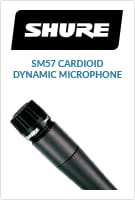
Shure SM57LC
Cardioid Dynamic Microphone Tweak advises: Great price on the classic all-purpose studio mic of all time. Good for instruments, vocals, drums, amps, and its practically indestructible. This has a standard XLR connector and does not come with a cable |
Oh yeah, rule of thumb borrowed from Computer Tweaks. "Never trust anything at revision 1.0". Of course, the industry is hip to that. When a piece is released, its usually at 1.1. It's really 1.0 in disguise, and will be finished around 1.3. Fortunately, the music gear industry moves slower than the computer industry. Products usually enjoy a 3-5 year shelf cycle, even longer if they are successful. It's ok to wait a year after release and get the finished, mature, stable product.
| Time Out! Is there a best time of year to buy gear? |
| Yep! It works sort of like the car industry. The new models come out in September and October so in July, August and early Sept. is a great time to make a deal. But not on all gear. See, musical instruments have a 3-7 year lifespan on store shelves, so it helps to know what is blowing out. How do you find that out? Hehe, you come back to TweakHeadz and participate on the boards and we'll let you know. Basically, you keep an eye on NEW gear to see what is replacing what. Check out my Hot new Products page from time to time. A true product blowout does not last long. Usually a few weeks and all the old stock is gone |
FX box A has 4 knobs and does one thing, lets say, delay. FX Box B has 4 knobs and does delay, chorus, reverb, panning, sampling, vocoding, harmonizing, phase shifting, exciting, amp distortion, ring modulation, noise gating, compressing and costs half the price! Box A has a luxurious sound. Box B sounds harsh, annoying, tinny, digital. Features look good on paper, but don't always sound good in music. If you buy cheap, you may end up buying again.
There are other variables too! Cost of service? What about Upgrades? Will it still be worthy in 5 years, standing up to future, more powerful gear we can barely imagine? This is particularly an issue with software. Assuming computers will continue to become more powerful, the software packages of today are bound to pale compared to successive generations. The risk here is of being orphaned. This is when a company drops a product line to develop another one, usually based on their ability to make a better profit. That's business. If you see a software company doing that, best to steer clear, and go with products that have a giant user base that makes it profitable to keep the flag flying.
Tweak's bottom line is sound. I've said it before, and I will again, these variables start to fall in place when you focus on your sound coming out the speakers. Great sound never goes out of style. Analog, 12 bit or 24 bit is not as important as the sound you perceive and its ability to evoke your creativity. Consider that, and the headaches of which gear may ease up a bit for you.
Go to the Next Class
Go to the Previous Class
|
Cool Quote: "Music was invented to confirm human loneliness." Lawrence Durrell (19121990), British author |
|
See and discuss Tweak's picks
of the week |
|
TweakHeadz Lab | Studio-Central | Audio-Pro-Central | zZounds and online store Affiliations | Site Map | Support the Lab | Privacy Policy | ©2008 TweakHeadz.com |