Getting
a good preamp is something that is
not easy to do. Along the way there are many stumbling blocks, things
that get in your way before you finally get down to business and pay.
There must be a hundred reasons to not spend a lot of money on a preamp,
a piece of gear that only does one thing, boost your microphone or instrument
signal to line level. Last year I counted up the number of mic preamps
I had in my studio. I was aghast to realize I had over 50 mic preamps,
46 of them on mixers, and that I used one or two of them on a regular basis.
How was I to justify getting a box that had "just one more"? Especially
one that had none of the features we are accustomed to getting.
The ME-1NV falls into the "wire+gain" philosophy
of preamp. That is to say, there are no frills, no extra circuitry
to run the sound through. No EQ, compression, gate, scooper, de-esser,
harmonic shifter, nothing. There's no digital signal path, no s/pdif,
ADAT, no big VU meters, just the basics.
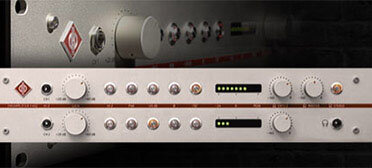
It comes in a 1/2 rack 1 unit high case
of thick metal. A bit heavier than you'd expect and all the switches
are solid. The gain control is a stepped control, and you have a choice
of settings in 5db increments from 5db to 60db. The Output level knob
is smooth and variable from -10 to +10db. Fully pushed to the max
there is 70db of gain which is plenty for any dynamic or condenser mic and
probably for most ribbons as well. In addition to the usual phantom
power and polarity switches, there is a switch for "loading" and for "impedance".
These can give your mics a slightly different sound and response characteristic.
Where you set the output can also affect the sound. You can push the
gain up high and decrease the output level into minus territory for a more
vintage sound, or lower the initial gain and boost the output for a more
modern sound, according to the documentation.
There is also a HiZ input for electric
guitars, basses, or whatever instrument level devices you wish to amplify.
Works great. My guitars come through as clean as I could want, with
a nice texture for mixing.
Subjective characteristics:
First test: Acoustic guitar/Shure SM81. The first thing that I noticed
in the first minute was the awesome sense of pressure coming from my recorded
audio tracks. It was a character that could be felt as well as heard.
Perhaps it is this sense of dynamics that lead people to say its a great
pre for pop music. Its got punch. Second Test: Vocals
(mine) with an SM57 and then an RE20 by Electro voice. The SM57 sounded
so good I had to check to make sure I did not make some mistake and record
into the wrong mic! My first thought was heck, throw the rest of the

mics away, this is all I need. Until I tried the RE20, which was even
better with plenty of high end but no harshness. Oddly I found the
RE20 to sound better than the Neumann TLM 103 with the ME-1NV, at least
with my voice, yet the Neumann had all of its characteristic smoothness,
now in greater relief.
Though the ME-1NV is not regarded as one
of the quietest preamps, to me, with my limited experience with high end
preamps it was very quiet with a rich detailed sound. While I can
imagine a more "transparent" sound, and a more "neutral" sound, I'd have
a hard time convincing myself that is what I really want. So far it
has been able to take everything i have thrown at it.
Count me as a satisfied customer.
After all the years of messing around with lesser preamps and spending lots
of cash on things that did not as profoundly affect recorded sound, I have
to wonder why it took me so long.
Go to the studio-central
Mic Preamp
forum
More Articles on Microphones and Preamps by Tweak
Mics and Preamps Index of Articles
Microphones Introduction
Mics under $100
Set up a Vocal Session
How to Process Vocal Tracks
Recording Vocals
ShureSM81
M-audio Solaris
Cad E200
Mic Preamps
High Quality Mic Preamps
Great River ME1-NV
FMR's Really Nice Preamp
Voicemaster pro
Shure SM7b
Sennheiser MD421
Rode NT1a
ElectroVoice RE20
TLM 103 by Neumann
Shure SM57
Microphone Prices
Prices of Mic Preamps