| |||||||||
21 ways to assemble a home recording RIGpage 5
| ||||||||
|
|
|
Any MIDI keyboard
Multi track recorder like the Alesis HD24XR (no computer needed)
|
|
|
|
Computer of choice
|
As time goes on in out home studio enterprises we collect gear. Keeping it all "online" and ready for your production becomes a challenge in itself. Mixerless options become cost-prohibitive when you exceed 24 inputs, and this is also the case for those using all but the most expensive digital mixers. The Analog 8-bus mixer comes to rescue. Indeed, it is the classic approach to the large home studio that has been used for over a decade, with great results and unmatched flexibility. Back in the late '80s and '90s this was THE approach to use. You can add anything you want--24 track digital recorders, 16 track reel to reels, cassette, DAT, and most importantly to us now, your 8x8 or enhanced 16x16 DAW audio interface. With the large board at the center, you can choose either the multi-track or DAW approach or even run both if you want
This system takes space, and is ideal for multi-room setups where you have a "control room" and a "studio room" where the performers play. The big 8-bus boards have a talkback monitoring system built into the mixer, to which you connect a second set of active monitors.
I chose the MX9000 for this page because I had it and love it and its relatively inexpensive. Other options are the Mackie 24-8 and 32-8, the Toft ATB series (which we have a discussion on here) which is about all you can find under $10,000. Pro analog boards are making a comeback and are very expensive. All of these boards have a "Mix B" functionality which, in terms of the MX9000, gives it 48 channels, not counting the 12 returns. You have 6 sends and 8 busses and main, control room, studio and 2 headphone outs. What's more there are 24 inserts and 24 direct outs. If this is not enough you can add a second mixer to it easily, making it awesome in terms of pure connectivity. A 100 channel board is definitely within reach if you need it. You have the flexibility to record full bands, mic up drum kits, or add a huge arsenal of hardware synths and processors. You can also use it to monitor all the outputs of your audio interfaces, connect DAT and Tape, and do bounces throughout the system, to and from computers and outboard recorders. You can also set up a 5.1 surround monitoring system if you want.
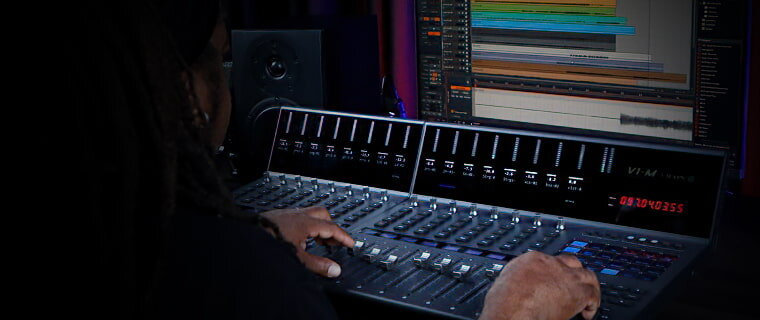
Add a control surface
for real fader automation for your sequencer. Yet let the analog board do the summing rather than doing pure digital bounces in the sequencer. I think you will find, as i do, that analog mixing is still a preferred way to mix, and adds an organicity lacking in much of today's digital mixes. The drawback to rigs of this nature is the incredible investment in cables and cable management one has to do.
Patchbays may be as much a curse as a blessing. With so many cables in the mix you really should go balanced all the way. This helps a lot.
We have an
ongoing discussion of the MX9000 at studio-central.
Who it is for:
Bands who need a board for their gigs, yet also need it for recording rehearsals at their home studio. With a modular multi track recorder, the Onyx 32 can record your band on location as it provides a house mix.
Hooking it up:
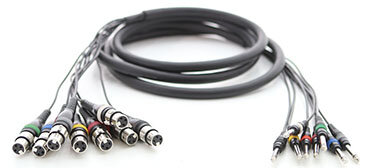
The snake goes to the XLR inputs of the Onyx and Mics and line instruments are connected to the snake on stage or in the recording room. If a Multi track recorder is used, it is connected to the Onyx 32 direct outs. A DBX Driverack may be used to control output to powered monitors
Here it is. You have a band and you need a rig for gigs and you want to bring it back to your rehearsal space and be able to track that next CD, so the rig should be able to record while you are gigging too. This is not the biggest Onyx, but its a good size for the working band; it will record everything you have on stage to its own track in the Mackie HDR and mix to the mains and the performers' stage monitors at the same time. Advantages here are the sound qualities of the Onyx preamps and Perkins EQ, onboard compression and limiting to help you get the most from your PA.
In the studio it will work for recording and playback of 16 tracks simultaneously dedicating half the board to inputs and half to outputs of the recorder. (You can reconfigure it any way you want with a patchbay, for example 8 in, 24 out, etc.).
The Onyx 32 has 6 sends and 4 busses for configuring stage monitors and sound reinforcement. It has direct outs on every channel for routing to a multi-track recorder. You get inserts for adding additional gear.
On a budget, take a look at the less expensive Onyx 24 and the Onyx 1640 If you need a larger 8 bus format there are the bigger Onyx 2480 and 3280 consoles.
|
TweakHeadz Lab | Studio-Central | Audio-Pro-Central | zZounds and online store Affiliations | Site Map | Support the Lab | Privacy Policy | ©2008 TweakHeadz.com |